

Since Mayor Adams left office, the New York City legislature has been revisiting some ideas that he disfavored and are overturning his vetoes. One of them might make it easier to buy a home in New York City.
One of Adams’ vetoes that was recently overturned was targeting the bill “Int. No. 1120.” Known as Chapter 36, the Sale of Cooperative Apartments, it is an attempt to restrict the seemingly endless power of Co-Op boards to delay rendering a decision on a potential purchaser’s application.
Chapter 36 restricts co-op boards in multiple ways, but here is what you should know if you are buying or selling a unit in a cooperative:
- First, Chapter 36 does not apply to Co-Ops organized pursuant to the private housing finance laws in which their purchases are conditioned to approval by a state or city agency (sometimes known as “HDFCs”). It also does not apply to any Co-Ops containing less than 10 dwelling units.
- All Co-Op boards are required to have a standardized application process, with a list of required materials and fees associated with the application available to prospective purchasers and sellers.
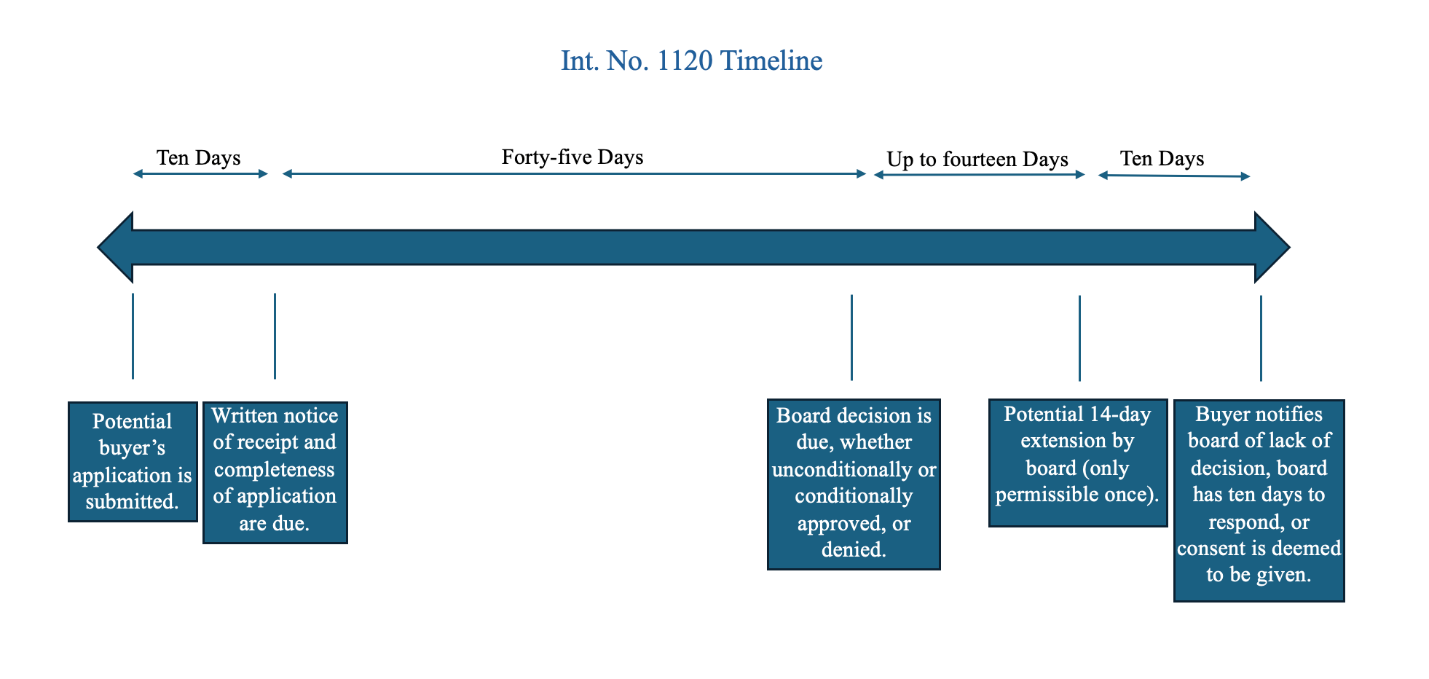
- Once a prospective purchaser has submitted an application, the Co-Op board has fifteen days to provide written notice to the prospective purchaser both in email and, if possible, by registered mail. This notice must inform the prospective purchaser that the board received their materials and note any missing materials. This rule applies to both initial and subsequent applications.
- In the event that a Co-Op board fails to provide notice to prospective purchasers that their application is incomplete, the submitted application will be deemed to be complete.
- If the board does not meet in the months of July and August, and has a memorandum in place stating so, then the deadlines are tolled during this period.
- Once the board has received the complete application, it has up to 45 days to decide whether to approve, conditionally approve, or deny the application. The board may, one time, extend that 45-day period by 14 days without the consent of the prospective purchaser. The board may also request further extensions from the purchaser.
- If no decision is rendered after 45 days, and the Board has exercised their right to extend or requested an additional extension from the purchaser, the prospective purchaser may issue a written notice to the board noting their failure to provide a decision, and the board then has ten days to decide (that ten-day time frame must be communicated in the purchaser’s notice).
- If, after the ten-day period, the Board still has not rendered a decision, the application may be deemed approved under the statute, subject to how the law is interpreted and enforced in practice.
For those Co-Op boards that do not comply with the above deadlines, there are strict penalties. On the first instance that a Co-Op board fails to meet one of the prescribed timeframes, a $1,000.00 fine is imposed. The second time the board fail to meet the deadlines, the fine increases to $1,500.00, and for each subsequent failure the penalty increases to $2,000.00.
Below is a timeline flow chart showing how new law is anticipated to affect the coop application process.
For more information, or to speak with a licensed real estate attorney, reach out to info@whfirm.com or call us at 212-832-7400.
This article is for general informational purposes only and is not intended as legal advice. The application and enforcement of laws may vary based on specific facts and evolving interpretations.